
In one clear definition
Mornings feel rushed. Transitions feel chaotic. Simple things turn into tension. And after a while, it starts to feel like: "Why does everything depend on me?" This happens because the system relies on constant reminders instead of structure. And when everything depends on reminders, everything depends on you.
Family routines are predictable structures that move daily responsibility out of constant supervision and into the flow of everyday life.
They reduce the need for repeated reminders, ongoing negotiation, constant decision-making, and emotional escalation around simple tasks. Responsibility grows when children are not just told what to do — but are given consistent opportunities to participate inside a stable structure.
Why daily family life often feels harder than it should
Many families are not lacking effort. They are lacking structure. When routines are unclear, every step has to be decided again, every transition managed, and every responsibility reminded. This creates an exhausting system where the adult holds the plan, tracks the timing, initiates action, and follows through—while the child merely responds.
Over time, this creates more friction, more tension, more repetition, and more emotional load. And far less sense of flow.
"Reminders create short-term compliance. Routines create long-term responsibility."
Why reminders don’t work long-term
Many parents rely on reminders because they work in the moment. But over time, they create a hidden pattern that keeps responsibility external.
The Reminder Loop
- The adult remembers, initiates, and prompts.
- The child merely responds.
- The child doesn't need to remember because someone else will.
- Leads to "I already told you" frustration.
The Routine Shift
- The structure holds the expectation.
- The child learns to anticipate and initiate.
- Responsibility moves from parent to the flow of the day.
- Reduces tension and builds capability.
What responsibility actually means
Responsibility is often misunderstood as obedience—doing things because you are told, reacting to pressure, or avoiding consequences.
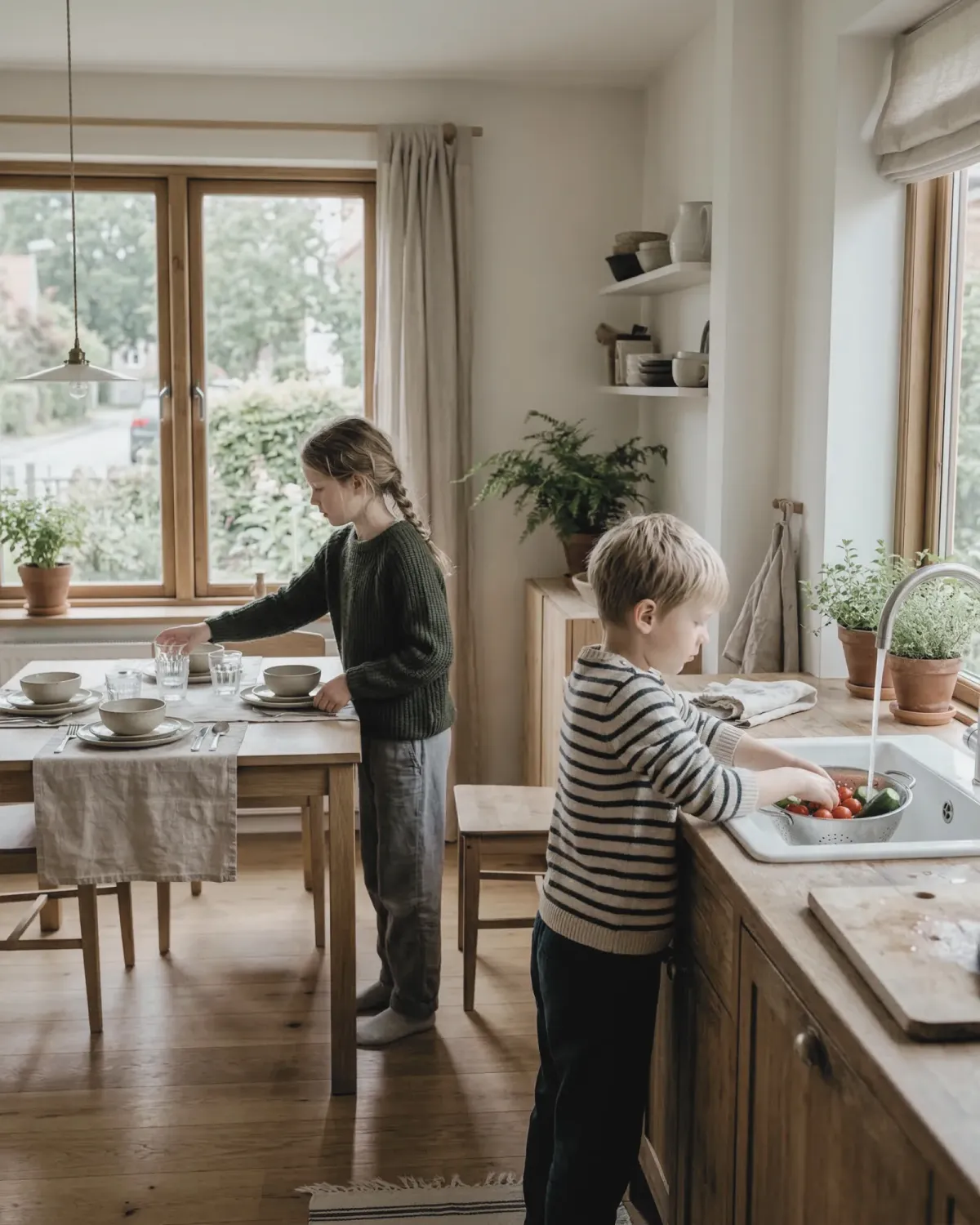
Real responsibility is noticing what needs to be done, remembering without constant prompting, following through, contributing to shared life, and taking ownership over time. And responsibility does not grow through pressure. It grows through participation. Children become more responsible when it is expected, repeated, structured, and developmentally appropriate.
What this looks like in everyday life
Routines change one crucial thing: they move responsibility from the parent into the structure. Instead of constant questioning ("Did you pack your bag? Brush your teeth?"), the structure carries the expectation.
- Mornings: Instead of constant reminders and rushing, there is a predictable sequence the child learns to move through.
- Leaving the house: Instead of last-minute chaos, there is a known flow of preparation.
- School preparation: Instead of the parent organizing everything, the child begins to carry parts of remembering and preparing.
- Tidying up: Instead of conflict and resistance, there is a repeated expectation built into daily life.
- Evenings and transitions: Instead of negotiation and escalation, there is a rhythm the child recognizes.
These changes are not dramatic. But they are powerful because they reduce the need for constant intervention.
Why routines reduce friction and mental load
Friction in family life often comes from uncertainty, repeated decisions, unclear expectations, and constant correction. Routines reduce friction because they remove the need to renegotiate everything. They make expectations visible and predictable.
For the parent, this is transformative. When routines are weak, the parent holds, tracks, and manages everything. When routines are strong, the system holds part of the process, reducing mental fatigue, constant monitoring, and the feeling that "everything depends on me." Routines do not remove effort. But they make effort more sustainable.
What parents often misunderstand
"I just need to remind more consistently"
More reminders usually do not solve the problem. They reinforce the system where the parent carries everything.
"My child should already know this"
Knowing is not the same as doing consistently. Consistency comes from structure, not expectation alone.
"Routines feel too strict"
Routines are not about rigidity. They are about reducing chaos. When the world feels more predictable, children resist less, cooperate more, and regulate more easily. Structure is not the opposite of connection; it supports it.
"My child resists structure"
Children often resist pressure — not structure. There is a difference. This is not about control; it is about design. You move from constant management to structured participation.
Want to understand what pattern your family is currently running on?
If daily life in your family often feels repetitive, tense, exhausting, or dependent on constant reminders, it may not be about trying harder. It may be about changing the structure.
Take the 2-minute Scandinavian Parenting Assessment to identify what may be creating friction, dependence or overload — and where a small shift in structure could make daily life significantly easier.
Take the 2-Minute Assessment